
Broken Algorithms and Aussie Slickbacks
monday long read

Welcome back to After School Monday Edition, a not-so-brief trends debrief for paid subscribers. 🫶
In today’s letter:
Catfishing ICE agents on Tinder, protesting inside Roblox
Gen Z wants love but isn’t ready for it
$300K party tables and the longevity benefits of raging
Ballet flats are now “cheugy”
Logo-ed undereye patches have been deemed “performative”
2016 makeup is back, clean girl is dead
Walmart Wirkins > Hermès Birkins for 72% of Gen Z
Peel-off lip stains up 388%, plum mascara up 292%
The “disgustingly educated” TikTok trend won’t cure brain rot
And so much more, plus everything I’m buying, reading, and listening to. But first, my favorite TikTok of the week:

 Tiktok failed to load.
Enable 3rd party cookies or use another browser
THE MACHINE IS BROKEN
This week, I was reminded of the many ways that algorithms can fail us — and that was before TikTok’s algorithm completely crashed yesterday, pushing slop onto the FYPs of millions of panicked users.
On Tuesday, an X user called Graza’s new mayo packaging “Canva-slop,” the de facto insult for when something looks AI-generated. Except it wasn’t! The labels were, in fact, hand-illustrated, a deliberate throwback to vintage cartoon aesthetics. The very same day, New York Times reporter Kyle Buchanan was accused of using ChatGPT to draft his tweet, merely because he used the sentence structure “didn’t just X, it Y” — nevermind that ChatGPT is trained on the very articles Buchanan writes and the only reason AI uses that sentence structure so frequently is because that sentence structure is so frequently used by professional writers.
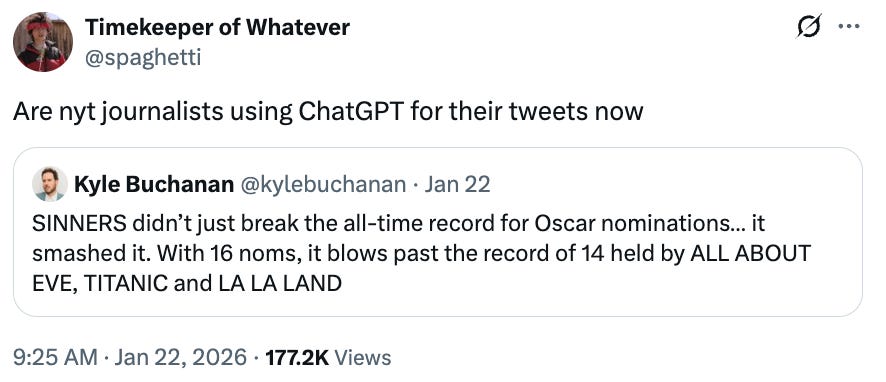
We’re so entangled in our algorithms that we’re beginning to think what’s fake is real and what’s real is fake.
Meanwhile, social media algorithms are trapping users in content loops based on narrow trajectories like “dating → engagement → wedding → pregnancy → parenting,” continuing to serve irrelevant content even after users’ lives diverge from these paths. Media theorist Elizabeth Losh told Mashable that platforms “slice and dice audiences by gender, age, political loyalties, and other categories, manufacturing needs and desires for each stage of life.” That explains why my Reels algorithm insists on showing me stay-at-home mom content even though I’m neither a mom nor a homemaker.
In response, people are trying to escape the algorithm and “cure brain rot” via all sorts of ways, from the continued rise of analog tech to TikTok’s new “disgustingly educated” trend, which has users posting book stacks and library visits as an aesthetic antidote to doomscrolling.


Psychologist Tracy King told Glamour it won’t work:
“Even educational TikToks are still delivered at high-speed and this is the issue,” she says. “TikTok is an algorithm-driven environment that rewards novelty over depth. It can help someone remember what learning feels like, but it does not rebuild the muscles of attention, reflection or synthesis. Those only return when the brain is allowed to slow down and stay with something long enough for meaning to form.”
On the bright (?) side, if TikTok’s algorithm really is as irrevocably broken as it seemed yesterday, we’ll soon have no worthwhile algorithms to escape from.
PLATFORM PROTESTING: DATING APPS, ROBLOX, AND ICE
On Tinder, coordinated groups are catfishing suspected ICE agents to expose their identities. Inside Roblox, kids are staging virtual immigration raids and counter-protests. These platforms weren’t designed for activism, but activism found them anyway.